TradingKey - U.S. core PCE inflation for July met expectations, but resilient inflation reignited expectations of Fed rate hikes, sending the three major U.S. stock indices slightly lower. Markets are focusing on Fed Chair Kevin Warsh's speech at the Jackson Hole annual symposium on Friday to seek trading direction ahead of the September 16 policy meeting.
At the close, the Dow Jones Industrial Average fell 0.21% to 53,463.88; the Nasdaq Composite Index slipped 0.08% to 26,130.20; and the S&P 500 Index dropped 0.02% to 7,675.70.
Tech Stock Performance
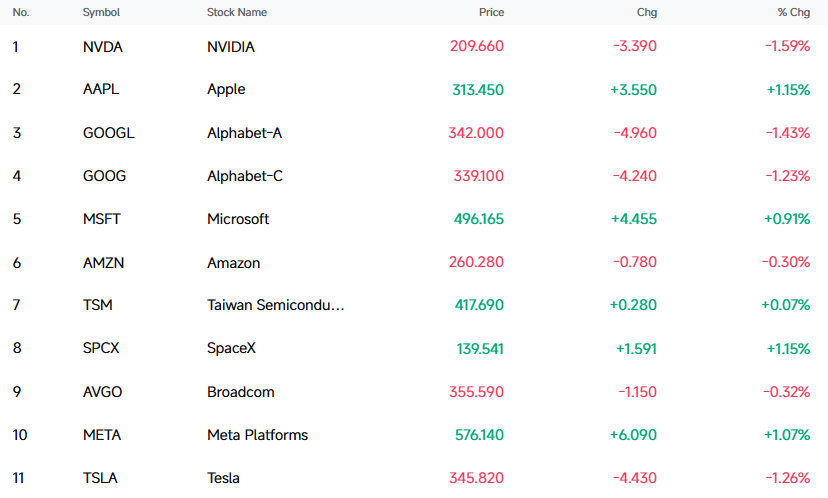
Meta (META) rose 1.07% to $576.14.
Meta reached an agreement with U.S. state and territorial attorneys general worth up to $16.7 billion, while agreeing to implement a series of safety restrictions for minors on Facebook and Instagram, bringing an end to a federal trial that had entered its second week. Meta previously estimated that if it lost, cases in California, Colorado, Kentucky, and New Jersey alone could face up to $1.4 trillion in fines, a figure that once approached the company's current market value.
Among mega-cap tech stocks, SpaceX (SPCX) rose 1.15%, Apple (AAPL) gained 1.15%, Meta Platforms (META) advanced 1.07%, and Microsoft (MSFT) added 0.91%. On the downside, Nvidia (NVDA) fell 1.59%, Google (GOOGL) dropped 1.43%, Tesla (TSLA) slipped 1.26%, Broadcom (AVGO) lost 0.32%, and Amazon (AMZN) declined 0.30%.
[Source: FutuBull]
The Philadelphia Semiconductor Index gained 0.2% to 11,611.24. Among its 30 constituents, 19 rose and 11 fell.
Among memory stocks, Western Digital (WDC) rose 4.02%, Seagate Technology (STX) gained 3.01%, SanDisk (SNDK) advanced 1.26%, and Micron Technology (MU) added 0.58%; SK Hynix (SKHY) fell 0.95%.
Company News
Anthropic Strikes $45 Billion AI Compute Deal with Nscale
Anthropic has agreed to pay Nscale $45 billion over the next six years to lease approximately 460 megawatts of AI compute capacity at its Monarch data center in West Virginia. According to people familiar with the matter, Nscale will utilize Nvidia (NVDA.O) Vera Rubin chips, with the capacity expected to begin coming online late next year. The entire Monarch campus has a planned capacity of about 1.35 gigawatts and a total investment of roughly $71 billion, with around $47 billion allocated for AI chips, while the remaining facilities will begin providing compute capacity in 2028. The project was originally slated to be leased by Microsoft, but Microsoft pulled out this summer, and Anthropic subsequently stepped in as the tenant.
Meta Settles Social Media Addiction Lawsuits, to Pay Up to $18 Billion
Meta has reached an agreement with state and territorial attorneys general across the U.S., agreeing to pay up to approximately $18 billion and implement a series of safety restrictions targeting minors on Facebook and Instagram, bringing an end to the federal trial that had entered its second week. Meta previously estimated that if it lost, cases in California, Colorado, Kentucky, and New Jersey alone could carry fines of up to $1.4 trillion, a figure that at one point approached the company's current market valuation.
Apple to Unveil First Foldable iPhone on September 9 Pacific Time
Apple will hold its largest product launch event of the year on September 9 at 10:00 a.m. Pacific Time, marking the first major new product launch led by John Ternus since taking over as CEO. Apple is expected to introduce its first foldable iPhone, which is roughly the size of a standard passport when folded and expands to a screen size close to a small iPad, representing the biggest design overhaul in the iPhone's nearly 20-year history. Apple also plans to release the iPhone 18 Pro and Pro Max, featuring faster chips, improved battery life, and major camera upgrades, with at least the larger model equipped with a mechanical aperture. The second-generation iPhone Air and the standard iPhone 18 will be delayed until next spring. New Apple Watch models may also debut at the event. Outgoing CEO Tim Cook will remain as executive chairman.
Industry & Macro News
US Core PCE Rises 0.2% MoM in July, In Line with Expectations
The US core Personal Consumption Expenditures (PCE) price index rose 0.2% month-on-month in July, meeting market expectations and up from 0.1% in June. The year-on-year increase remained at 3.3%, also consistent with expectations and the previous reading. Although core PCE did not accelerate further, it remains well above levels consistent with the Federal Reserve's 2% inflation target, indicating that underlying inflationary pressures have not fully abated.
The headline PCE price index, which includes food and energy, rose 0.2% month-on-month and 3.7% year-on-year, exceeding the market expectation of 3.6%. By price component, goods prices fell 0.1% month-on-month in July, somewhat easing overall inflation pressures; services prices rose 0.3%, driven by continued upward movement in categories such as financial services, insurance, and housing, reflecting persistent stickiness in services inflation.
Up to Half of Planned US Data Centers Face Risk of Delay or Cancellation, Firm Says
Ben Dell, co-founder of investment firm Kimmeridge, stated that up to 50% of planned data centers in the US could be delayed or canceled due to rising political opposition, litigation, and the complexity of physical infrastructure development, noting that "the Silicon Valley model is colliding with real-world infrastructure constraints." Dell added that US natural gas demand is projected to increase by about 30 billion cubic feet per day in the future, with data centers potentially contributing 5 billion to 10 billion cubic feet; however, project delays could cause AI-related demand to land at the lower end of the forecast range. As the US midterm elections approach, data centers are rapidly becoming a political issue, with bipartisan opposition growing in several states, including Pennsylvania, Texas, and Ohio.
Iran Claims Agreement Reached with Oman on Strait Revenue Sharing, US Intervention Delays Process
According to Sepah News, the official news website of Iran's Islamic Revolutionary Guard Corps (IRGC), IRGC spokesman Hossein Mohbi stated regarding the latest situation in the Strait of Hormuz: "The Strait of Hormuz is currently under our control, and no enemy warships are present in the Persian Gulf." He added: "From a military and territorial jurisdiction perspective, no vessel can pass through this waterway without Iran's permission and management." Mohbi noted: "The Strait of Hormuz belongs to Iran and Oman, which lies across the sea from us. About a month ago, we initiated negotiations with Oman and reached a mutually acceptable outcome." "In these talks, several agreements were reached regarding the respective shares of the strait's waters owned by the two countries, as well as the share of revenues derived by Iran and Oman." "The US is interfering in this process, which has delayed the relevant work." He emphasized: "If the US does not accept our conditions, the Strait of Hormuz will never be opened."
Find out more